Quick answer: A refrigerator that is warm while the freezer stays cold usually has a frosted evaporator coil, a stuck damper or a dead evaporator fan blocking the cold air that should move from freezer to fridge. Unplug it for 24 hours with the doors open; if it cools again afterwards, the defrost system has failed and needs a part. Typical repair in Sacramento: $125–$500. Expert Repair Company: $99 diagnostic, waived with repair, (279) 225-1050.
If your refrigerator is not cooling but the freezer works, the most common cause is a frozen evaporator coil blocking the airflow the fresh-food section depends on. Nearly every household refrigerator makes cold in the freezer and moves it to the fridge side with a fan through a damper. When that path is iced over, the fan is dead, or the damper is stuck, the freezer stays cold and the fridge slowly warms up. Here is how I sort it out on a service call in Citrus Heights, in the order I actually check things.
Quick checks you can do safely in 10 minutes
Unplug the refrigerator before you reach behind or under it, and leave screwed-in panels alone.
- Temperature settings. A bumped dial or a reset after an outage can push the fridge to its warmest setting. Set the fresh-food side to 37°F and the freezer to 0°F.
- The air vent. Cold air enters the fridge through a vent on the back wall, usually top center. A pitcher or an overpacked shelf against it can warm the whole compartment.
- The fan. Open the freezer and press the door switch with a finger. You should hear a fan spin up. Silence or a scraping noise points to the evaporator fan.
- Door gaskets. Close the door on a dollar bill. If it slides out with no resistance, the gasket is not sealing.
- Time. After an outage or a move, give the unit 24 hours before you assume a fault.
- Condenser dust. Pull the front kick grille and vacuum what you can reach.
What not to do: do not open the sealed refrigerant system, do not tap or pry at the compressor, do not bypass a door switch or defrost thermostat, and do not use a heat gun on the plastic freezer liner.
Causes, from most to least common
1. Frozen evaporator coil (defrost failure)
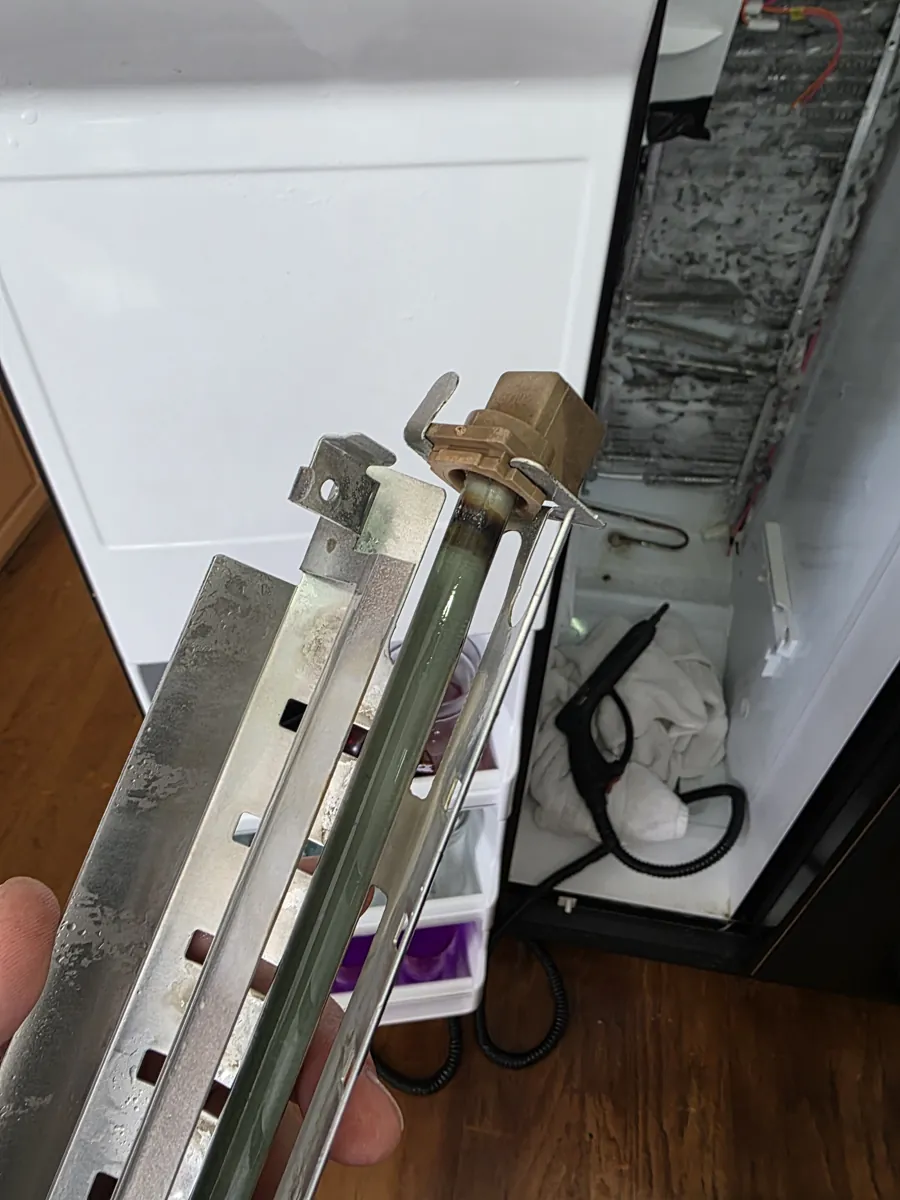
The fridge warmed up over a few days, the freezer back panel has heavy frost, and the fan sounds muffled. If you unplug the unit for 24 hours with the doors open and it works for a week afterward, this is your answer. The failed part is in the defrost circuit: the defrost heater, the defrost thermostat, or the timer or control board that commands the cycle. A manual defrost is a fine stopgap. Finding the failed part is a technician job.
2. Evaporator fan motor
The freezer is cold, the fridge is warm, and you hear no fan at the door switch, or you hear a loud whine that stops when the door opens. The part is the evaporator fan motor behind the freezer back panel. Technician job on most units, since the panel is often iced in.
3. Damper stuck closed
The fan runs but no air comes out of the fridge vent. On French-door models the damper control assembly sits at the top of the fresh-food section. It is a motorised flap with its own thermistor, and a bad thermistor gives the same symptom, so diagnosis matters. Technician job.
4. Dirty condenser coils or condenser fan
Both compartments run a few degrees warm, the compressor never stops, and the kick panel feels hot. In a Sacramento garage in July this is the first thing I check. Cleaning the coils is DIY. Replacing the condenser fan motor is a technician job.
5. Thermistor
The fridge swings between too warm and frozen lettuce, or the display temperature does not match a thermometer on the shelf. The fresh-food thermistor is a cheap part, but it needs a resistance check to confirm. Technician job.
6. Door gasket
Condensation on the shelves, frost near the door edge, a gasket that is torn or has lost its grip. DIY if you order the exact model gasket. Also check that the fridge tilts slightly back so the doors swing shut on their own.
7. Control board
The fan and damper work when powered directly, but the board never calls for them. The main control board should be the last part replaced, not the first. Technician job.
8. Compressor or sealed system
The freezer is not truly cold either. Ice cream stays soft and the compressor runs hot and clicks every few minutes. The part is the compressor start relay, the compressor, or a refrigerant leak. Sealed-system work is an EPA 608 job by law.
When to stop and call
Stop when the manual defrost did not help, when the fan runs but no air moves, when the compressor is hot and clicking, or when food has spoiled once already. From there the diagnosis needs a meter and a panel removed. Expert Repair Company handles refrigerator repair throughout the Sacramento area, and I carry the common evaporator fans, dampers, and defrost parts for Samsung, LG, Whirlpool, and GE on the van. Call (279) 225-1050 between 8:00 AM and 5:00 PM, Monday through Friday. Same-day appointments are often available.
What the repair usually costs
National figures put typical refrigerator repair at $125 to $500, with a gasket at $75 to $200, a control board at $200 to $500, and a compressor at $700 to $1,250. A defrost or fan repair sits near the low end. The full breakdown, including whether a 10-year-old fridge is worth fixing, is in our refrigerator repair cost guide.
Brand note: Samsung and LG
Many Samsung French-door models ice up behind the fresh-food evaporator cover and drip water into the crisper drawers before the fridge goes warm. Water under the drawers is the same defrost problem, caught early. LG uses a linear compressor on many models; when it weakens, the freezer softens first and the fridge follows, which is a sealed-system issue rather than a defrost or fan issue. Both brands are common in Roseville and Folsom homes built in the 1990s and later, and I stock fans and dampers for them. More brand-by-brand notes are on the brands we repair page. If the ice maker quit at the same time, that is usually the same airflow problem, not a separate fault; see ice maker repair.
Garage refrigerators in Sacramento summer heat
Garages in Citrus Heights, Fair Oaks, and Orangevale routinely pass 100°F in July and August. A standard refrigerator is designed for room temperature. In a hot garage the condenser cannot shed heat, the compressor runs nonstop, and the freezer keeps up while the fridge falls behind. If your garage fridge only misbehaves in summer, clean the coils, pull it a few inches from the wall, and consider a garage-rated unit next time. A fridge that fails only on 105°F days is often overworked rather than broken.

Call before the food goes
If the quick checks did not fix it, do not keep restarting the fridge and hoping. Expert Repair Company is in Citrus Heights, CA and serves Roseville, Folsom, Orangevale, Fair Oaks, and Carmichael. The diagnostic fee is $99 and is waived when you approve the repair. See the refrigerator repair page for details or call now.